

Brain Hyperarousal and Difficulty Falling Asleep: Neurophysiology of Evening Neural Overdrive

- Introduction
- Key mechanism: cognitive hyperactivation
- Neurophysiology of the process
- Subjective perception
- Common misinterpretations
- Connection with daytime brain function
- Behavioral and environmental factors
- Sleep and long-term health
- Safe lifestyle adjustments
- When to consider consulting a specialist
- FAQ
- Conclusion
Introduction
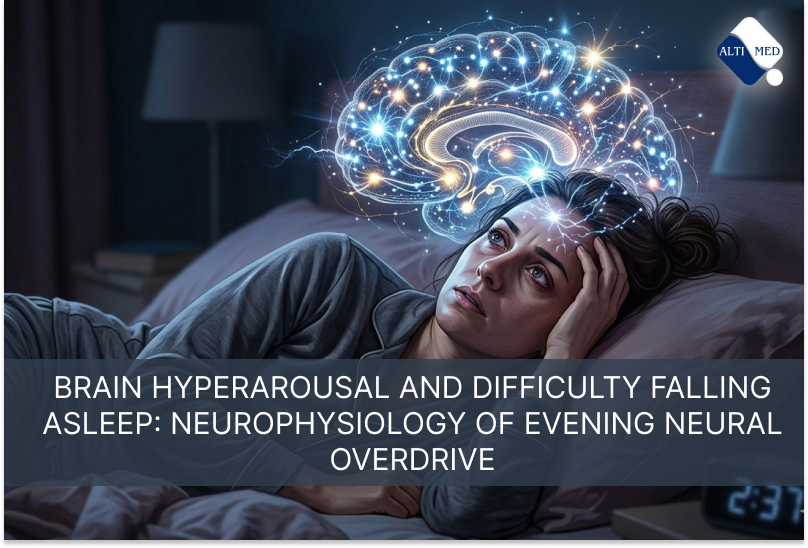
The state in which a person experiences significant fatigue yet cannot transition into sleep is often associated not with the “absence of sleep,” but with the functional characteristics of the nervous system during evening hours. In scientific literature, such conditions are described through the concept of increased cognitive and neurophysiological activation.
This is not a single symptom but a complex regulatory pattern of wakefulness involving cortical attention networks, stress systems, the autonomic nervous system, and circadian mechanisms.
Key mechanism: cognitive hyperactivation
Under normal conditions, the evening reduction of wakefulness is accompanied by decreased activity in prefrontal and associative brain regions. However, during periods of high mental load or stress overload, this process may slow down.
A state of sustained cognitive activation may develop, characterized by:
- persistent internal dialogue
- increased tendency toward analysis and forecasting
- heightened processing of emotional stimuli
- difficulty transitioning to passive modes of neural activity
Such a state is not necessarily linked to external events and may evolve as a habitual neurobehavioral pattern.
Neurophysiology of the process
From a neurophysiological perspective, pre-sleep hyperarousal is associated with an imbalance between:
- arousal systems (reticular formation, noradrenergic and glutamatergic networks)
- inhibitory systems (GABAergic mechanisms, thalamo-cortical rhythms)
Additional contributing factors include:
- increased sympathetic nervous system activity
- persistence of high-frequency cortical activity
- delayed reduction of brain metabolic activity
These mechanisms may make the transition from wakefulness to sleep physiologically less stable.
Subjective perception
Individuals may describe this state in various ways, commonly reporting:
- a sensation of a “crowded” or overloaded mind
- inability to stop the flow of thoughts
- internal tension despite physical fatigue
- subjective acceleration of time before sleep
It is important to note that subjective intensity does not always correspond to objective sleep parameters.
Common misinterpretations
Hyperarousal is often perceived as a sign of a severe sleep disturbance, although it may reflect:
- an adaptive response to overload
- a temporary state of wakefulness regulation
- an individual neuropsychological trait
Misinterpretation can increase anxiety, which in turn may maintain cognitive activation.
Connection with daytime brain function
Evening hyperactivation is frequently linked to patterns of daytime neural functioning, including:
- prolonged sustained attention
- high informational density of the environment
- emotional overload
- irregular recovery periods
In this context, sleep functions not only as rest but also as a key mechanism for neural processing of accumulated information.
Behavioral and environmental factors
Evening neural activation may be influenced by:
- intensive use of digital devices
- irregular activity schedules
- high levels of evening light exposure
- absence of transitional routines between activity and rest
These factors are not direct causes of sleep disturbance but may contribute to instability in the sleep onset process.
Sleep and long-term health
From the perspective of long-term physiological functioning, stable transition into sleep is associated with:
- restoration of neural networks
- maintenance of cognitive reserve
- regulation of hormonal rhythms
- mitochondrial resilience in brain cells
- modulation of inflammatory processes
Chronic instability of evening neural deactivation may be considered a factor influencing metabolic and neurodegenerative aspects of aging.
Safe lifestyle adjustments
Within scientific models of sleep regulation, the following behavioral approaches are often discussed:
- establishing consistent daily activity rhythms
- gradual reduction of sensory load in the evening
- creating predictable transitional states before sleep
- limiting cognitive stimulation during late hours
These measures are viewed as supportive strategies for physiological wake-sleep regulation.
When to consider consulting a specialist
Professional consultation may be reasonable if:
- the state persists over an extended period
- significant decline in daytime functioning occurs
- notable subjective distress is present
- symptoms coexist with other neurological or somatic manifestations
FAQ
Conclusion
Brain hyperarousal before sleep represents a complex regulatory state involving cognitive, neurophysiological, and behavioral mechanisms.
Understanding these processes allows difficulties with sleep onset to be viewed not as an isolated symptom, but as part of broader dynamics of nervous system functioning.


