

Fusion/Fission: how mitochondria “remodel” — and why it matters for energy and resilience

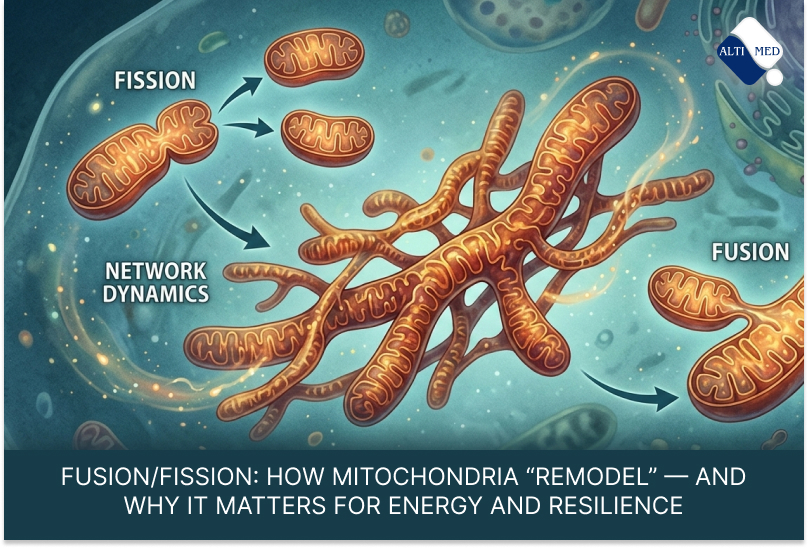
Mitochondria are often imagined as separate “batteries” inside a cell. In reality, in many tissues they behave as a dynamic network: they can join together and they can split into smaller units. These processes are called fusion and fission. This “plasticity” is not cosmetic—it is one way the cell maintains mitochondrial quality, distributes energy to where it is needed, and responds to stress.
Network dynamics influence how efficiently mitochondria produce energy, how well they handle damage, and how quickly a cell can adapt when demands change. At the same time, it is important to avoid oversimplifications: “fusion is always good, fission is always bad” is not correct. Under normal conditions, both fusion and fission are essential parts of a healthy balance.
In this article we will explain how mitochondrial dynamics work, what affects them, which nonspecific patterns may accompany dysregulation, what people often confuse, and which safe steps support baseline resilience.
Key mechanism
Fusion is the process in which mitochondria join together, forming longer, more connected structures. This may help to:
- “dilute” local damage by distributing components across the network;
- support steadier energy production during sustained demands.
Fission is the process in which mitochondria split into smaller fragments. This is needed to:
- rapidly redistribute mitochondria to areas of the cell with high energy demand;
- separate damaged segments, which are then easier to route for disposal (mitophagy);
- maintain renewal and “rebuilding” of the network in response to stress and metabolic change.
The core idea is simple: the cell manages not only the amount and “quality” of mitochondria, but also the shape and organization of the network to match current tasks. Dynamics are linked to other mechanisms such as biogenesis (building components), mitophagy (removing damaged units), antioxidant defenses, and inflammatory signaling.
What it depends on
Mitochondrial dynamics are influenced by how often cells face demand and how recovery is organized.
1) Physical activity and type of load
Different activity patterns create different energy needs: short, high-intensity efforts require rapid energy redistribution; longer moderate work requires sustained output. The mitochondrial network can remodel accordingly. Overload without recovery more often disrupts balance and increases fragmentation.
2) Sleep and recovery
Recovery is a period when the cell coordinates repair processes and damage management. Chronic sleep deprivation can impair this coordination, making the network less stable.
3) Nutrition and metabolic signaling
Irregular eating, significant deficiencies, frequent blood sugar “swings,” and overall metabolic stress may influence mitochondria indirectly through hormones, inflammatory markers, and energy balance. Extreme restriction can also increase stress signaling.
4) Psychological stress and inflammatory background
Chronic stress changes neuroendocrine signaling, sleep quality, and behavior. At the cellular level, this often increases mitochondrial stress load, which can shift network balance toward dysregulation.
How dysregulation may present
An imbalance in fusion/fission does not produce a single recognizable symptom. When cellular resilience is reduced, in some cases nonspecific patterns may appear:
- reduced tolerance to load: normal tasks start to feel more draining;
- longer recovery after training or stress;
- “uneven energy,” with productive days alternating with “crash” days;
- stronger sensitivity to sleep loss (fatigue arrives faster, focus is harder to maintain);
- a subjective feeling of muscle “heaviness” with small increases in activity.
These patterns are highly nonspecific and often reflect more common causes—anemia, poor sleep, anxiety, chronic pain, endocrine issues, infections, nutrition-related problems. The point is not to self-diagnose “fusion/fission,” but to recognize that recovery quality and stress load matter even at a cellular level.
What people often confuse
- “Fusion is always good, fission is always bad”
Both are necessary. Too rigid a network can be as problematic as excessive fragmentation. - Confusing fragmentation with “destruction”
Fission is a normal management tool. The issue is a chronic shift in balance without restoration. - Confusing network dynamics with mitochondrial quantity
You can have a normal amount but poor organization/coordination, and vice versa. - Attributing every energy dip to mitochondria
Sleep, stress, deficiencies, thyroid issues, anemia, and medication effects are common drivers. - Expecting fast “retuning”
Cellular changes take time; stable adaptations typically develop over weeks. - Ignoring recovery
Trying to “improve mitochondria” using only load, without sleep and stress management. - Mixing dynamics with mitophagy and biogenesis
They are different: dynamics is organization, mitophagy is disposal, biogenesis is building. They interact but are not interchangeable.
Why this matters for long-term health (Longevity)
Mitochondrial dynamics matter for long-term health not as a standalone “technology,” but as part of system resilience:
- Tissue recovery: the ability to redistribute resources and manage damage affects repair efficiency after stress.
- Metabolic resilience: more coordinated network function supports stability of energy metabolism, especially when routines fluctuate.
- Low-grade inflammation: chronic cellular stress and mitochondrial imbalance can amplify pro-inflammatory signaling; network stability helps keep that background lower.
- Muscle function and functional reserve: muscles require rapid adaptation; network quality relates to activity tolerance and recovery.
- Cognitive resilience: the brain is sensitive to energy variability; stability supports attention and stress tolerance.
Longevity here is about resilience to overload, recovery capacity, and maintaining function—not promises of “rejuvenation.”
Safe steps
Below are foundational directions that usually support cellular resilience without extremes.
- Normalize recovery
Stable sleep and a predictable routine are often the highest-yield contributors to cellular stability. - Dose physical load
A mix of regular moderate activity and recovery periods tends to be safer than occasional overload. With prolonged depletion, it is often more reasonable to reduce intensity and re-build gradually. - Nutrition without extremes
Regular meals, adequate protein, and hydration. If deficiencies are suspected, it is safer to evaluate them with a clinician rather than “stack supplements” blindly. - Reduce chronic stress as a physiological task
Routine, movement, breathing/relaxation practices, and psychological support when needed can affect both subjective energy and biological resilience. - If symptoms persist, assess common medical drivers
Sometimes the key step is ruling out frequent blockers of recovery: anemia, thyroid dysfunction, sleep disorders, chronic inflammatory conditions.
Mistakes and myths
- Myth: “You can deliberately ‘switch on fusion’ to fix energy issues.”
Reality: it is a dynamic balance, not a single switch. - Myth: “More load always improves mitochondria.”
Reality: without recovery, load more often reduces resilience. - Mistake: trying to compensate for sleep loss with training or stimulants.
- Myth: “There is a universal supplement for the mitochondrial network.”
Reality: effects are context-dependent, and basics are often more important. - Mistake: ignoring persistent symptoms when there are clear red flags.
When to discuss this with a doctor
Discuss your condition with a clinician if you have:
- chest pain, significant shortness of breath with minimal effort, near-fainting or fainting episodes;
- persistent rhythm disturbances, pronounced swelling, rapidly worsening weakness;
- unexplained weight loss, prolonged fever, night sweats;
- significant fatigue lasting more than 4–6 weeks that limits daily functioning;
- new neurological symptoms (limb weakness, speech problems, coordination or vision changes);
- suspected sleep disorders (loud snoring with breathing pauses, severe daytime sleepiness).
FAQ
Conclusion
Fusion/fission are mechanisms that allow mitochondria to function as a living network—joining, splitting, and remodeling to match cellular demands. The balance of these processes influences load tolerance, recovery, and stress resilience, but it is not a single explanation for all symptoms. In a longevity framework, mitochondrial dynamics matter as part of functional reserve, metabolic resilience, and control of cellular stress. The safest ways to support this system are stable sleep, sensible load dosing, non-extreme nutrition, and reducing chronic stress—while paying attention to red flags that require medical evaluation.


