

Mitochondrial biogenesis: how the body builds “energy capacity” and what it means for how you feel

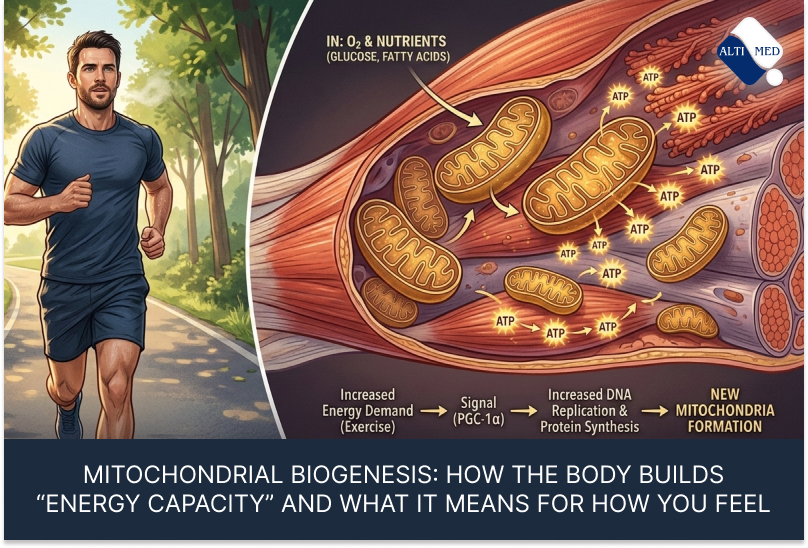
Mitochondria are not static “batteries” that either exist or do not. Cells can increase the number and functional capacity of mitochondria when energy demands change—for example, with regular physical activity, adaptation to cold, recovery after illness, or metabolic shifts. This process is called mitochondrial biogenesis.
Biogenesis is not about “making more mitochondria at any cost,” but about coordinated remodeling: synthesizing proteins, renewing membranes, tuning enzyme systems, and improving transport pathways so the cell can cope better with demand. In everyday terms, it resembles upgrading infrastructure: capacity increases, efficiency improves, and resilience to “overload” becomes higher.
At the same time, it is important to keep a scientific frame: biogenesis is one adaptation mechanism, but it does not explain every case of fatigue and it does not guarantee instant energy gains. It depends on recovery, sleep, nutrition, and overall stress load. Let’s look at how it works, what influences it, where misconceptions arise, and what can be done safely.
Key mechanism
Mitochondrial biogenesis is a process by which a cell expands its mitochondrial “fleet” and improves its functional performance. It involves several layers:
- Activation of regulatory programs: transcriptional “switches” turn on gene programs that increase production of respiratory-chain proteins, metabolic enzymes, and mitochondrial components. Popular science often mentions PGC-1α as a key hub in this network (without turning it into a “protocol”).
- Coordination between the nucleus and mitochondrial DNA: some mitochondrial proteins are encoded by nuclear genes, while others are encoded by mitochondrial DNA. Biogenesis requires coordinated work of both systems.
- Assembly and integration: new proteins and lipids must be delivered, inserted into membranes, and assembled into working complexes. This is not merely “more,” but more organized and functional capacity.
The end result is not “magical extra energy,” but increased aerobic capacity, more efficient substrate utilization, and better tolerance of repeated workloads.
What it depends on
Mitochondrial biogenesis depends on the signals the body receives and whether resources are available for remodeling.
1) Physical activity: the key stimulus
Regularity and dosing matter. Signals may come from:
- moderate aerobic activity (walking, running, cycling, etc. in a comfortable zone);
- interval-type sessions (an option, but not for everyone and not always);
- resistance training as a factor that improves muscle “metabolic architecture” and the ability to handle load.
Critically, a stimulus without recovery may not produce adaptation.
2) Recovery and sleep
Remodeling takes time. Sleep shapes hormonal and metabolic signaling and supports tissue recovery after training. Chronic sleep loss often undermines results even with a well-designed exercise plan.
3) Nutrition and substrate availability
Biogenesis is an energy-demanding program. Low protein intake, significant micronutrient deficiencies, chaotic eating patterns, and chronic overeating can interfere with adaptation. On the other hand, extreme restriction and constant “deficit at any cost” often worsens recovery as well.
4) Stress load and inflammatory background
Chronic stress changes sleep, appetite, activity patterns, and recovery. With a sustained inflammatory background, cells may focus on “survival mode” rather than adaptation.
How dysregulation may present
When adaptation and biogenesis do not progress as expected, it often shows up not as a specific symptom but as patterns:
- endurance barely improves despite regular training;
- recovery after exercise takes longer than expected;
- the feeling “I train but I have less energy,” especially with poor sleep or overload;
- marked day-to-day variability: fine today, “switched off” tomorrow;
- sleep quality worsens as training continues (often a sign the dose is not right).
Important: these patterns are frequently due not to a “broken biogenesis,” but to more common factors—mismanaged training load, insufficient recovery, inadequate nutrition, anemia, thyroid issues, chronic infections, pain syndromes, anxiety, and others. A more practical mindset is “what is blocking adaptation,” not “my biogenesis is impaired.”
What people often confuse
- Biogenesis ≠ simply “more mitochondria”: quality, organization, and matching tissue demand are crucial.
- Confusing endurance with motivation: lack of progress is often about recovery and dosing, not “willpower.”
- Believing only HIIT works: intervals are a tool, not a universal requirement for adaptation.
- Confusing post-workout exhaustion with effectiveness: feeling destroyed does not equal good adaptation.
- Blaming everything on mitochondria: low endurance can also reflect anemia, sleep problems, chronic pain, excess weight, anxiety, and more.
- Mixing biogenesis with mitophagy: biogenesis is “building/upgrading,” mitophagy is “cleanup and renewal”; they usually need to be balanced.
- Expecting fast results: cellular remodeling is measured in weeks and months, not days.
Why this matters for long-term health (Longevity)
Mitochondrial biogenesis is not only for athletes. In a long-term health context, it is linked to several systemic advantages:
- Metabolic resilience: improved ability of tissues to use oxygen and substrates is often associated with more stable energy and less “metabolic fragility.”
- Low-grade inflammation: regular adaptation and better metabolic regulation may reduce the tendency toward a chronic stress-like background (without promises or guarantees).
- Muscle function and “reserve” for the future: muscle is a major determinant of function with age. Preserving its ability to adapt supports long-term capacity.
- Cognitive resilience: brain and muscle are connected through metabolism, blood flow, and signaling molecules; improved overall resilience can influence quality of life and tolerance of stressors.
- Recovery capacity: a more adaptive system often tolerates stressors (illness, sleep loss, abrupt schedule shifts) better due to a larger functional reserve.
Longevity here means functional reserve, recovery, and system resilience—not promises of “rejuvenation.”
Safe steps
Below are foundational directions that often support adaptation without extremes.
- Build training from a base
Regular moderate aerobic activity 3–5 times per week often provides a stable stimulus. Increase intensity gradually. - Treat recovery as part of training
Sleep, easy days, and stress management matter. If progress stalls, it can be more effective to reduce intensity for 1–2 weeks than to “push harder.” - Eat to recover, not to punish
Adequate protein, regular meals, and hydration. If you feel strong fatigue while training, it is worth considering whether energy intake is sufficient and whether deficiencies are present. - Do not confuse stimulus with depletion
A common mistake is too much high intensity on a weak base. For many people it is safer to first build general endurance. - If symptoms persist, consider medical drivers
With prolonged fatigue or no progress despite an adequate routine, it may be reasonable to rule out common causes such as anemia, thyroid dysfunction, nutrient deficiencies, and sleep disorders.
Mistakes and myths
- Myth: “The harder the workout, the stronger the biogenesis.”
Reality: adaptation requires balance; overload more often harms recovery. - Myth: “You must train at the limit all the time.”
Reality: progress is usually built on regularity and appropriate dosing. - Mistake: ignoring sleep and trying to “get through” on caffeine or stimulants.
- Myth: “If there is no progress, you just don’t have enough mitochondria.”
Reality: many factors can block progress—from iron status and sleep to chronic stress. - Mistake: changing everything at once (diet, schedule, training), making it impossible to tell what helped or harmed.
When to discuss this with a doctor
Discuss your condition with a clinician if you have:
- significant shortness of breath, chest pain, or near-fainting during exercise;
- rapidly worsening weakness, swelling, or persistent heart rhythm issues;
- unexplained weight loss, prolonged fever, night sweats;
- marked fatigue lasting more than 4–6 weeks that limits daily activities;
- new neurological symptoms (limb weakness, speech issues, coordination or vision changes);
- suspected sleep problems (loud snoring with breathing pauses, severe daytime sleepiness).
FAQ
Conclusion
Mitochondrial biogenesis is an adaptation program that helps cells build and “tune” energy capacity in response to regular energy demands. It depends on appropriately dosed activity, sleep and recovery, nutrition, and overall stress load. Problems with endurance and energy are more often driven by an imbalance between stimulus and recovery and other common factors than by a single “fault” at the mitochondrial level. In a long-term health framework, biogenesis matters as part of functional reserve, metabolic resilience, and recovery capacity—without extremes and without promises of quick results.


