

Mitophagy: How the Body Renews Mitochondria — and What This Changes for How You Feel

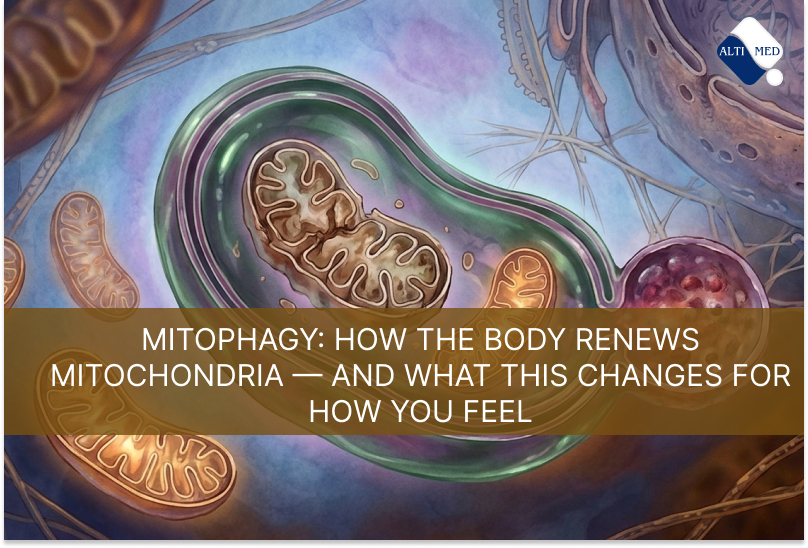
Mitochondria are not “parts” that function the same way for an entire lifetime: they continually wear out, remodel, and renew. One of the key renewal mechanisms is mitophagy—a process in which the cell recognizes damaged or “inefficient” mitochondria and removes them to make room for more functional ones. This is similar to regular maintenance: not for “rejuvenation,” but to preserve system performance.
Importantly, mitophagy is not a separate “button.” It is part of a broader cellular quality-control logic linked to energy balance, stress responses, and recovery. Under normal conditions it helps maintain metabolic stability and may reduce the risk of accumulating cellular damage. At the same time, oversimplifying the topic (“switch on mitophagy and everything will be fine”) usually creates unrealistic expectations.
In this article we will cover: how mitophagy works, what influences it, how dysregulation may present (without self-diagnosis), what people often confuse, and which safe steps can support physiological renewal mechanisms.
Key mechanism
Mitophagy is a specialized form of autophagy directed specifically at mitochondria. The essence of the process is:
- the cell assesses mitochondrial quality using functional “signals” (for example, membrane potential stability, signs of damage, and levels of stress markers);
- damaged mitochondria are tagged for disposal (by protein quality-control systems);
- then the mitochondrion is enclosed in a membrane structure (an autophagosome) and delivered to the cell’s “recycling” compartment (the lysosome), where components are broken down and partly reused.
Why this is needed: damaged mitochondria more often produce “noise” in the form of excessive reactive oxygen species (ROS), disrupt energy production, and may intensify cellular stress. Mitophagy helps maintain a pool of mitochondria of “acceptable quality,” especially in tissues with high energy demand (muscles, brain, heart).
What it depends on
Mitophagy is sensitive to routine and to the “environment” cells live in. In practice, four factor groups are most often discussed:
1) Sleep and circadian rhythms
Sleep is a period when recovery processes and cellular “cleanup” tend to run more coherently. Irregular sleep, frequent nighttime awakenings, and chronic sleep deprivation may reduce the coordination of restorative signals.
2) Physical activity (properly dosed)
Moderate training is often associated with improved “quality control” in muscles: exercise provides an adaptation stimulus, while recovery provides a window for renewal. Importantly, overtraining and inadequate recovery can have the opposite effect—raising stress load and contributing to prolonged fatigue.
3) Nutrition and energy balance
Mitophagy is embedded in systems that respond to energy availability. Marked imbalances (chronic overeating, inadequate protein intake, irregular calorie “swings”) may reduce metabolic resilience. At the same time, rigid schemes and extreme restrictions are not universal solutions and do not suit everyone.
4) Psychological stress and environmental factors
Chronic stress can increase the load on mitochondria and disrupt the balance between damage and recovery. Other factors may also matter: work-rest patterns, recovery after illness, certain external exposures, habits, and comorbid conditions.
How dysregulation may present
Mitophagy dysregulation is not a diagnosis and not “one cause of all symptoms.” But when cellular quality control is disturbed, in some cases nonspecific patterns can occur that are easy to confuse with other conditions:
- a feeling that “energy exists only for short bursts,” followed by a sharp drop;
- reduced tolerance for usual activity and a longer “crash” afterward;
- subjective mental “fog,” harder to maintain focus when fatigued;
- stronger sensitivity to sleep loss;
- a sense of an “inflammatory background” (aches, heaviness) without a clear cause—highly nonspecific and requiring careful evaluation.
Similar complaints are often explained by other causes: anemia and iron metabolism issues, thyroid dysfunction, chronic sleep loss, anxiety, infections, chronic pain, medication side effects, sleep-related breathing disorders, and more. Therefore, the more accurate approach is not to “find mitophagy in yourself,” but to look at the overall picture.
What people often confuse
- Confusing mitophagy with “just autophagy”: mitophagy is a specific subtype and its regulation is tissue-specific.
- Attributing any fatigue to mitochondria: sleep, stress, depression/anxiety, anemia, inflammatory processes, and medication side effects are often primary.
- “The more ROS, the worse”: some ROS acts as an adaptation signal; problems begin with imbalance and chronic overload.
- Belief that supplements can “switch on” mitophagy: evidence is heterogeneous; effects depend on context, doses, and baseline status.
- Extreme practices as a universal answer (strict fasting, overheating/cold exposure, excessive training): stimulus without recovery can worsen the situation.
- Replacing cause-and-effect with assumption: “my energy is low → mitophagy must be broken.” In reality, this is a hypothesis, not a conclusion.
- Ignoring psychophysiology: chronic stress-axis activation changes sleep, appetite, activity, and perceived energy even without a primary “failure” at the mitochondrial level.
Why this matters for long-term health (Longevity)
Mitophagy matters not as a “trendy biohack,” but as a component of systemic resilience:
- Tissue recovery and repair: a higher-quality mitochondrial pool supports the energy demands of repair and regeneration.
- Metabolic resilience: when cells better handle fluctuations in activity and nutrition, “metabolic swings” are less likely.
- Low-grade inflammation: damaged mitochondria can intensify cellular stress and pro-inflammatory signals; quality control helps reduce that background.
- Muscle function: muscles are a large “metabolic organ”; their adaptation and recovery are closely linked to mitochondrial quality.
- Cognitive resilience: the brain is energy-dependent; maintaining energy stability may affect subjective clarity and attentional endurance, especially during stressful periods.
Longevity in this context is about system resilience (recovery, adaptation, metabolic stability), not promises of “rejuvenation.”
Safe steps
Below are general directions usually considered a foundation. They are not treatment and do not replace evaluation of the causes of symptoms.
- Stabilize sleep
A consistent wake time, reducing evening stimulation, and light hygiene often improve the predictability of recovery. - Dose activity by the “stimulus + recovery” principle
Regular moderate activity is usually more helpful than rare “all-out” efforts. If you feel prolonged depletion, it may be reasonable to temporarily reduce intensity and increase recovery. - Nutrition without extremes
Adequate protein, regular meals, the quality of carbohydrates/fats, and sufficient hydration. If there are significant dietary restrictions or GI symptoms, individualized discussion with a specialist is preferable. - Reducing chronic stress as a physiological task
Not “think positive,” but build routine, physical activity, breathing/relaxation practices, and psychological support when needed. - Check basic medical drivers if complaints are persistent
Sometimes the most practical step is to rule out anemia, thyroid disorders, deficiencies, chronic inflammatory processes, and sleep disorders (for example, sleep apnea).
Mistakes and myths
- Myth: “You can reliably boost mitophagy with one habit.”
Reality: it is a complex system that depends on context and baseline status. - Mistake: “If you feel worse after exercise, you should train even harder.”
Sometimes this indicates insufficient recovery or improper dosing. - Myth: “The more dietary restriction, the better the cellular renewal.”
Extreme restriction may worsen sleep, hormonal regulation, and recovery. - Mistake: ignoring chronic sleep loss while hoping to “compensate” with supplements or stimulants.
- Myth: “All symptoms come from mitochondria.”
It is often more accurate to see mitochondria as one layer rather than the only cause.
When to discuss this with a doctor
Seek medical evaluation if you have:
- rapidly progressive weakness, significant shortness of breath with minimal exertion, or chest pain;
- fainting, persistent heart rhythm disturbances, pronounced swelling;
- unexplained weight loss, prolonged fever, night sweats;
- significant fatigue lasting more than 4–6 weeks that clearly limits everyday functioning;
- new neurological symptoms (limb weakness, speech problems, coordination or vision changes);
- suspected sleep disorders (loud snoring with breathing pauses, severe daytime sleepiness).
FAQ
Conclusion
Mitophagy is a cellular quality-control mechanism that removes damaged mitochondria and supports the energy resilience of tissues. Its function depends on sleep, activity dosing, nutrition, and chronic stress load, while signs of dysregulation are typically nonspecific and easily confused with other conditions. In a long-term health framework, mitophagy matters as part of recovery capacity, metabolic resilience, and the control of low-grade inflammatory stress. The safest way to support these mechanisms is to begin with basic, non-extreme habits and not ignore “red flags” that warrant a medical discussion.


