

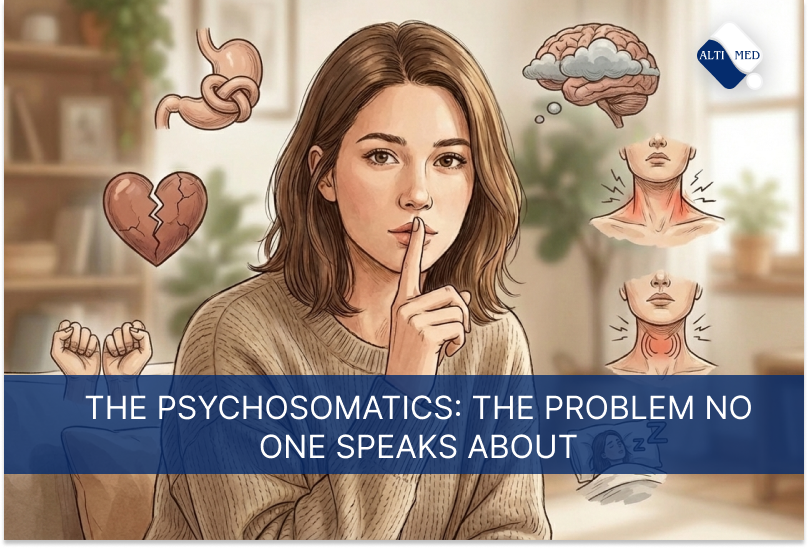
The Psychosomatics: The Problem No One Speaks About

- 1. Introduction: Why Psychosomatics Is One of Today’s Most Overlooked Health Issues
- 2. What Is Psychosomatics? An Expert Overview
- 3. Why Psychosomatics Remains Largely Unspoken
- 4. How Stress and Emotions Convert into Physical Symptoms
- 5. The Altimed Approach: Diagnosing the Undiagnosed
- 6. Treatment That Works — Beyond Medication
- 7. Why a Functional, Integrated Approach Matters
- 8. When to Consider a Psychosomatic Evaluation
- 9. FAQ — Quick Answers for Patients
- 10. Conclusion: Psychosomatics — The Hidden Piece You Can Address Today
1. Introduction: Why Psychosomatics Is One of Today’s Most Overlooked Health Issues
In modern medicine, we often separate the body from the mind. We treat pain with medication, infections with antibiotics, and injuries with surgery — but we rarely ask:
What if the root cause of your symptoms isn’t purely physical?
What if your body is sending you messages from the mind?
This is the domain of psychosomatics — the study of how psychological stress, emotional tension, and mental patterns manifest as real physical symptoms.
Psychosomatic conditions are not “imaginary.” They are very real physical reactions rooted in psychological states — and they often go undiagnosed, misunderstood, or ignored entirely.
2. What Is Psychosomatics? An Expert Overview
The term “psychosomatics” comes from the Greek psyche (mind) and soma (body). It refers to physical symptoms caused, triggered, or worsened by emotional and psychological stress.

Common psychosomatic manifestations include:
- chronic pain without clear structural pathology
- gastrointestinal discomfort (bloating, IBS-like symptoms)
- tension headaches or migraines
- sleep disorders
- fatigue and “burnout”
- heightened anxiety and muscle tension
These symptoms are not “all in your head” — they are the body’s real physiological responses to persistent emotional stress.
3. Why Psychosomatics Remains Largely Unspoken
Despite its prevalence, psychosomatics is rarely addressed head-on for several reasons:
3.1. The Mind-Body Divide in Medicine
Most healthcare models still separate mental health from physical symptoms. A patient with stomach pain sees a gastroenterologist, not a stress specialist — even when stress is the underlying trigger.
3.2. Social Stigma
Many people fear being told their symptoms are “psychological.” This leads to underreporting and miscommunication.
3.3. Lack of Integrated Diagnostic Tools
Traditional diagnostics (blood tests, imaging) may show nothing abnormal — but that doesn’t mean nothing is wrong. Without functional or psychosomatic assessments, the real cause remains hidden.
4. How Stress and Emotions Convert into Physical Symptoms
Psychosomatics isn’t random. The body responds to prolonged stress through a well-documented chain of physiological events:

4.1. Stress Hormones and Nervous System Overdrive
Chronic stress elevates cortisol, adrenaline, and sympathetic nervous system activity. Over time, this leads to:
- muscle tension
- disrupted digestion
- poor sleep
- immune dysregulation
4.2. Brain-Body Communication
Neuroscience has shown that brain regions involved in emotion (like the amygdala) directly influence:
- pain perception
- autonomic function
- gut motility
- sleep centers
This is why emotional stress can trigger a migraine or IBS-like symptoms even without a clear organic cause.
5. The Altimed Approach: Diagnosing the Undiagnosed
At Altimed, we believe in seeing the whole person, not just isolated symptoms.
5.1. Functional Diagnostics with ATM-Express
The brain-body interface demands precision. Altimed uses advanced, non-invasive functional scanning via the ATM-Express device to:
- identify nervous system imbalance
- detect autonomic stress
- evaluate emotional and somatic regulation
This approach reveals patterns that traditional tests often miss, allowing clinicians to pinpoint whether psychosomatic stress is contributing to the symptoms.
6. Treatment That Works — Beyond Medication
Psychosomatics isn’t cured by a pill alone. The solution lies in restoring balance across body systems, neurological regulation, and emotional processing.

6.1. Transcranial Magnetic Stimulation (TMS) — ATM-TR
TMS is a gentle, non-invasive method that:
- regulates overactive stress circuits in the brain
- reduces anxiety and emotional overload
- promotes calmer neural patterns
- improves sleep and mood stability
It’s especially effective for patients whose symptoms don’t respond to conventional approaches.
6.2. Exogenous Bioresonance (Lanta Series)
Bioresonance therapy modulates physiological rhythms to support:
- nervous system harmony
- emotional balance
- resilience to stress
Lanta devices help the body ‘re-tune’ its regulatory responses, easing psychosomatic tension without medication.
6.3. Endogenous Optimization (Helper-BRT)
Helper-BRT promotes internal self-regulation by:
- enhancing autonomic balance
- stabilizing hormonal responses
- supporting immune and nervous communication
- reducing the impact of chronic stress on the body
It’s ideal for integration into a broader stress management and wellness program.
7. Why a Functional, Integrated Approach Matters
Standard medical tests often:
- return “normal” results despite real suffering
- overlook emotional contributions
- rely on symptom suppression
Altimed’s integrated model bridges the gap between emotional stress and physical manifestation, providing pathways not only to relief but to recovery and resilience.
8. When to Consider a Psychosomatic Evaluation

People commonly overlook psychosomatic contributions until patterns persist:
- symptoms resistant to traditional treatments
- recurring pain without clear structural cause
- chronic fatigue or low energy
- sleep disturbance despite lifestyle changes
- anxiety, tension, or somatic stress symptoms
If you relate to any of these, an integrated psychosomatic assessment may uncover the real drivers of your condition.
9. FAQ — Quick Answers for Patients
10. Conclusion: Psychosomatics — The Hidden Piece You Can Address Today
Psychosomatic symptoms are common, overlooked, and treatable. They don’t mean weakness — they mean the body has been under sustained stress and is signaling distress.
With modern functional assessment and integrated therapy solutions such as:
- ATM-Express scanning
- TMS (ATM-TR)
- Bioresonance (Lanta series)
- Helper-BRT optimization
you can finally identify, address, and heal patterns that no one speaks about — but that affect millions.
👉 If physical symptoms persist despite treatment, don’t accept “nothing is wrong.”
Psychosomatics may be the missing piece — and Altimed offers the tools to understand it.


