

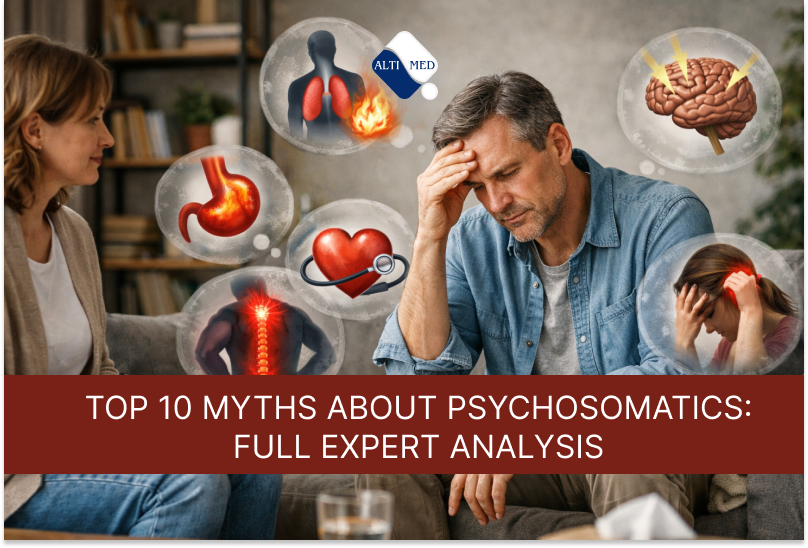
Top 10 Myths About Psychosomatics: Full Expert Analysis

- 1. Myth 1: “Psychosomatics is unproven”
- 2. Myth 2: “Psychosomatic symptoms are imaginary”
- 3. Myth 3: “A person is to blame for their psychosomatics”
- 4. Myth 4: “A psychologist is the only specialist who treats psychosomatics”
- 5. Myth 5: “Psychosomatics is just stress”
- 6. Myth 6: “Positive thinking cures psychosomatics”
- 7. Myth 7: “Psychosomatics occurs only in women”
- 8. Myth 8: “If you stop thinking about it — it will go away”
- 9. Myth 9: “Psychosomatics occurs only in chronic conditions”
- 10. Myth 10: “Psychosomatics is treated only with talking”
- 11. Diagnostics and Treatment of Psychosomatic Dysfunctions at Altimed
1. Myth 1: “Psychosomatics is unproven”
Why the myth exists
Many people confuse psychosomatics with esoterics or superficial interpretations like “you attracted the illness yourself.” Because of this, it seems like there is no science behind it.
What medicine says
Modern psychophysiology has proven the connection between emotions, the nervous system, immunity, and hormones. Key mechanisms include:
- hyperactivation of the hypothalamic–pituitary–adrenal axis during prolonged stress;
- increased cortisol levels affecting inflammation and immunity;
- neurovegetative dysregulation that manifests as spasms, pain, tachycardia, digestive disturbances.
Conclusion
Psychosomatics is a clinically proven field of medicine that studies how emotional processes affect bodily functions.
2. Myth 2: “Psychosomatic symptoms are imaginary”

Why the myth persists
Symptoms may change — appear and disappear — which gives the impression that they are “not real.”
Physiology of the symptom
A psychosomatic symptom is a consequence of:
- muscle spasm;
- vascular spasm;
- changes in autonomic tone;
- disrupted neural connections;
- imbalance in neurohormonal regulation.
These are real biological processes that can be measured through functional diagnostics.
Examples
- “Lump in the throat” — spasm of laryngeal muscles
- “Weakness” — exhaustion of the nervous system
3. Myth 3: “A person is to blame for their psychosomatics”

False logic
The myth is based on the belief that a person consciously controls their emotions.
Real causes
Psychosomatics arises from processes that do not depend on willpower:
- automatic reaction of the amygdala;
- biological threat response;
- accumulated behavioral patterns;
- childhood defense mechanisms;
- chronic tension of the autonomic nervous system.
Why guilt is harmful
Feeling guilty increases stress and worsens the condition. Psychosomatics is not a “bad character,” but a neuropsychophysiological reaction.
4. Myth 4: “A psychologist is the only specialist who treats psychosomatics”
Where the error lies
A psychologist works with emotional causes, but not with physiological consequences.
Who is really needed
Psychosomatics requires a multidisciplinary approach:
- functional diagnostics physician — evaluation of organ function;
- specialist in autonomic regulation — restoration of nervous system balance;
- psychotherapist — work with triggers and patterns;
- device-based medicine (TMS, bioresonance, neuromodulation) — restoration of physiology.
Why complexity is important
If you work only on emotions but do not restore the nervous system, the symptoms return.
5. Myth 5: “Psychosomatics is just stress”

Why this is incorrect
Stress is only the trigger.
What lies deeper
Psychosomatics involves:
- chronic overactivation of the sympathetic system;
- vagal regulation disorders;
- emotional reaction patterns;
- muscular-fascial blocks;
- disruptions in brain rhythms.
Stress ≠ psychosomatics
Stress is an everyday concept. Psychosomatics is a clinical model describing the interaction between emotions and physiology.
6. Myth 6: “Positive thinking cures psychosomatics”

The value of positive thinking
Yes, it reduces cortisol levels and improves mood.
But this is not enough
Psychosomatic symptoms are linked to deep neurophysiological processes:
- autonomic imbalance;
- disruption of neural circuits;
- chronic anxiety reactions;
- musculoskeletal-visceral spasms.
What actually treats
Methods that affect physiology and the nervous system.
7. Myth 7: “Psychosomatics occurs only in women”
Where the myth comes from
Men seek help less often and tend to “endure” more. Because of this, it may appear that the problem is “female.”
What the data shows
Psychosomatic reactions occur equally in both genders.
More common in men:
- heart pain;
- blood pressure spikes;
- panic states.
More common in women:
- irritable bowel syndrome;
- migraines;
- hormonal disorders.
Physiology is the same
Psychosomatic mechanisms are universal.
8. Myth 8: “If you stop thinking about it — it will go away”

Mechanism of the error
Repressed emotions do not disappear — they turn into physical reactions.
What happens
- sympathetic tone increases;
- neurohormonal balance is disrupted;
- internal tension grows;
- spasms and pain intensify.
Why repression is dangerous
The body tries to “release” accumulated stress, making symptoms stronger.
9. Myth 9: “Psychosomatics occurs only in chronic conditions”
Fact
Psychosomatic reactions can be acute.
Acute manifestations
- panic attacks;
- hyperventilation;
- sharp abdominal pain;
- blood pressure surges;
- migraine-like pain;
- heart rhythm disturbances without pathology.
Why this happens
During strong emotional overload, the nervous system reacts instantly.
10. Myth 10: “Psychosomatics is treated only with talking”

Why this is wrong
Talking helps understand the cause, but does not restore physiology.
Modern approach includes
- psychotherapy;
- neuromodulation (TMS);
- Helper frequency devices;
- restoration of brain rhythms;
- balancing the autonomic nervous system;
- correction of sleep, breathing, and hormonal regulation.
Only a comprehensive approach works
Both the mind and the body must be treated.
11. Diagnostics and Treatment of Psychosomatic Dysfunctions at Altimed
11.1. ATM Device-Based Diagnostics
Identifies:
• early organ dysfunctions,
• the level of stress load on the nervous system,
• autonomic imbalance,
• the true cause of symptoms.
Allows distinguishing psychosomatics from organic pathology.
11.2. TMS Therapy (ATM-TR Device)
A painless neuromodulation method that:
• reduces brain hyperactivation,
• eliminates anxiety,
• normalizes sleep,
• removes psychosomatic reactions,
• restores balance between the cortex and the limbic system.
Does not cause side effects and is suitable for long-term treatment courses.
11.3. Helper Series Devices
Portable frequency devices that can be carried in a pocket:
• reduce anxiety,
• stabilize the nervous system,
• improve sleep,
• support the condition between TMS sessions,
• are suitable for home therapy.


