

Vitamin B2 (Riboflavin): Deficiency Symptoms Affecting Mucous Membranes and the Eyes

- Introduction
- 1) Vitamin B2: biological role and why it matters for “fast-renewing” tissues
- 2) Vitamin B2 riboflavin deficiency symptoms: a typical pattern
- 3) Cracks at the corners of the mouth: the B2 factor and what to consider
- 4) Riboflavin for the eyes: why the eye surface may react early
- 5) Sources of B2: where it is found in the highest amounts
- 6) Riboflavin daily requirement: what needs depend on
- 7) B2 and light sensitivity: can there be a connection?
- 8) Can there be excess B2?
- FAQ (9 questions)
- Conclusion
Introduction
Vitamin B2 (riboflavin) is a water-soluble vitamin required for enzymes involved in energy metabolism and for maintaining tissues with a high renewal rate. Such tissues include mucous membranes and the skin in areas exposed to constant mechanical and chemical stress, as well as structures of the eye. Therefore, early signs of riboflavin insufficiency often affect the corners of the mouth, the lips, the tongue, and the eyes’ sensitivity to light.
1) Vitamin B2: biological role and why it matters for “fast-renewing” tissues
Riboflavin is converted in the body into coenzyme forms (FAD and FMN), which participate in redox (oxidation–reduction) reactions. These reactions are needed for:
- producing energy from food;
- supporting cellular “repair” and renewal;
- protecting cells from metabolic stress at the level of enzyme systems.
Tissues that constantly renew (mucosa, epithelium) are especially sensitive to disruptions in enzyme processes that require B2.
2) Vitamin B2 riboflavin deficiency symptoms: a typical pattern
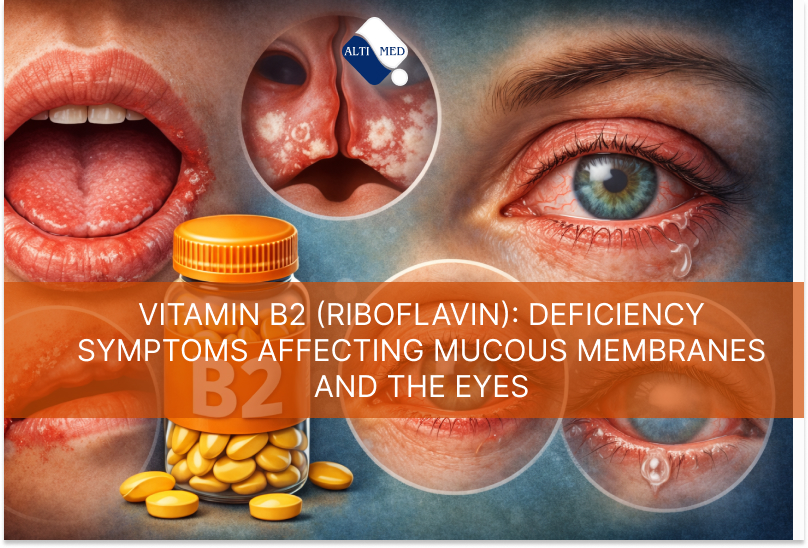
Riboflavin insufficiency most often shows up not as a single “marker,” but as a combination of signs related to mucous membranes and skin in transition zones:
- dryness, irritation, a feeling of “tightness” around the lips;
- discomfort at the corners of the mouth, tendency to cracking;
- changes in the tongue surface (burning, sensitivity);
- eye symptoms: tearing, a gritty sensation, increased sensitivity to light.
Important: these signs are not strictly specific only to B2 deficiency—similar complaints can occur with local irritation, infections, oral-hygiene issues, and deficiencies of other nutrients. However, the combination is a reason to evaluate diet and risk factors.
3) Cracks at the corners of the mouth: the B2 factor and what to consider
Cracks and inflammation at the corners of the mouth are often linked to riboflavin because this area:
- is under constant mechanical stress (speaking, eating);
- frequently contacts saliva;
- is sensitive to reduced epithelial resilience.
With low B2, barrier and repair processes may work less efficiently, and micro-injuries more easily turn into persistent irritation. In practice, however, there are always differential causes: from fungal/bacterial infection to bite issues and the habit of licking the lips. Therefore, diet is only part of the assessment.
4) Riboflavin for the eyes: why the eye surface may react early
The eye surface and the structures that maintain a stable tear film belong to tissues where normal cellular metabolism and repair are important. With riboflavin insufficiency, the following may occur:
- discomfort, a feeling of dryness;
- tearing as a response to irritation;
- light sensitivity (photophobia) as a subjective symptom.
These signs do not replace an ophthalmologic assessment, but they help explain why B2 is often discussed specifically in the context of eyes and mucous membranes.
5) Sources of B2: where it is found in the highest amounts
Riboflavin is widely present in foods, but intake may decrease with a restrictive diet. The most typical sources include:
- dairy products;
- eggs;
- meat and organ meats;
- fish;
- green leafy vegetables, legumes, whole grains (their contribution depends on the diet).
A feature of B2 is light sensitivity: with prolonged storage under bright light, riboflavin content in some foods may decrease.
6) Riboflavin daily requirement: what needs depend on
Daily B2 needs depend on age, sex, and overall energy expenditure. In real life, status is most strongly influenced by:
- dietary variety;
- regular intake of source foods;
- gastrointestinal status and factors that affect absorption.
If the diet is low in animal-derived foods, it is important to plan B2 sources from plant groups and monitor overall nutrient density.
7) B2 and light sensitivity: can there be a connection?
Photophobia (increased sensitivity to light) can occur in many conditions—from dry-eye syndrome to inflammatory processes. With riboflavin insufficiency, it is discussed as a possible component of the “mucosal” pattern, especially when signs at the corners of the mouth and lips are also present.
With persistent light sensitivity, the priority is to rule out ophthalmologic causes; dietary correction is considered supportive, not a standalone solution.
8) Can there be excess B2?
Riboflavin is water-soluble, and when intake exceeds needs, excess is usually excreted in urine (bright-yellow coloration may occur). Toxicity from dietary intake is considered unlikely.
At the same time, supplement doses should be approached reasonably: the absence of frequent toxicity does not mean “more is better,” especially without signs of deficiency and without understanding the causes of symptoms.
FAQ (9 questions)
Conclusion
Riboflavin (vitamin B2) is involved in enzyme reactions that support cellular metabolism and tissue renewal, so with insufficiency, mucous membranes and high-stress areas often react first—the corners of the mouth, lips, tongue, and the eye surface. B2 deficiency symptoms are not strictly specific, but their combination helps suspect a nutrient contribution and review diet structure and riboflavin sources.


