

Psychosomatic Pain: When Tension Turns Into Tissue Damage

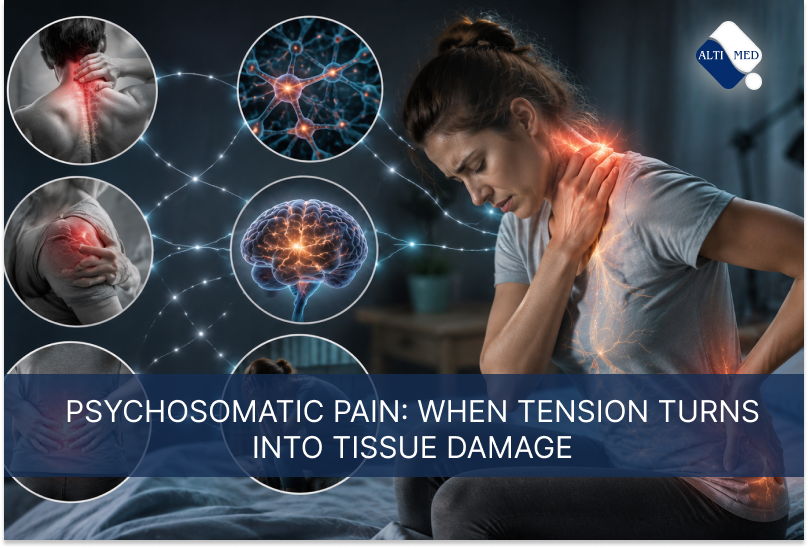
- Chronic Pain — Psychogenic Origin
- Stress or Suppressed Emotions as the Main Source of Chronic Pain
- How to Relieve Pain — From Practical Recommendations to Active Therapy
- ATM-Express Diagnostics and комплексная Therapy: Targeted Work with Psychosomatic Pain
- Therapy Methods Used at Altimed
- How the Treatment Process Works
- Appointment for Examination
Emotional state affects how the brain processes information. Anxiety, in turn, can increase both the duration and intensity of pain syndrome. Calmness and a sense of safety, on the contrary, reduce the intensity of pain. Pain caused by psychological stress or anxiety is called psychogenic pain. Its development is not associated with somatic, visceral, or neuronal damage. The cause lies in psychological factors.
Chronic Pain — Psychogenic Origin
Emotional state affects how the brain processes information. Anxiety can increase the duration and intensity of pain syndrome. Patients whose pain is associated with psychogenic factors describe it as exhausting and distressing. This pain cannot be removed with medications. It interferes with life, plans, and often becomes the central source of suffering and emotional exhaustion. During severe flare-ups, the pain may become so intense that a person cannot suppress groaning.
The main feature is that laboratory and instrumental examinations often show no abnormalities. No pathological changes are detected in the body. In such cases, the pain may be considered psychogenic in origin.
Back Pain and Psychosomatics
Psychogenic pain can appear throughout the body, but most commonly it affects the lower back. A person undergoes all necessary examinations, searches for connections between gastrointestinal organs and back pain, yet no cause is found. In such cases, the condition is often described as psychogenic or psychosomatic pain.
Its complexity is difficult to describe. The pain may change location and character. Standard methods usually do not relieve it. Patients often describe the condition as “the whole body hurts,” while painkillers provide little or no effect. During rest, the pain may even intensify due to changes in the functional state of the nervous system.
Why does this happen? Under stress, vascular tone, muscle tone, heart rhythm, and gastrointestinal functions change. Alterations in cerebral circulation and metabolic processes are also frequently observed. The nervous system becomes overloaded. As a result, the brain interprets many unpleasant sensations in the body as pain.
If attacks occur frequently, so-called “pain behavior” develops. To suppress unpleasant sensations, a person begins constantly using medications and supportive remedies.
Neck Pain and Psychosomatics
The neck muscles are a kind of bridge between the conscious and unconscious mind. They reflect flexibility in decision-making. Muscle blocks may hold inner anger, crying, or suppressed emotional reactions.
Pain syndrome may vary in intensity — from mild discomfort to sharp and exhausting pain. The pain may be short-term or long-lasting, acute or chronic. Regardless of the manifestation, psychosomatic factors may trigger it.
When a person remains under constant stress, the body stays tense. This negatively affects the brain, organs, systems, and muscle condition. Muscle tension leads to spasms in the neck area. The pain becomes pulling and progressive and often cannot be relieved by massage or medication.
Neck pain is frequently observed in women due to increased emotional sensitivity. Women often find it more difficult to cope with emotional overload even when external stress appears moderate.
Chronic neck pain is especially common among women involved in business activities while simultaneously carrying significant family responsibilities. The higher the level of stress and tension, the stronger the pain becomes.
Migraine and Psychosomatics
Stress negatively affects the entire body, including the brain. Frequent and intense headaches are common. Anxiety and stress increase pain perception and make migraine attacks longer and more severe. Headaches may lead to mood swings. During migraine episodes, pain intensity fluctuates dramatically.
The pain becomes unbearable, while common remedies provide little relief. In such cases, it is important to reduce muscle tension and normalize oxygen supply to blood vessels. This requires addressing the source of stress that intensifies the pain syndrome.
Stress or Suppressed Emotions as the Main Source of Chronic Pain
Chronic stress or suppressed emotions may lead to muscle spasms through psychosomatic mechanisms. In a state of prolonged stress, the body remains constantly tense. As a result, muscles stay contracted, pulse increases, and heart function becomes unstable. Stress triggers excessive cortisol and adrenaline release. The body works harder than normal. Muscles receive increased blood flow, digestion slows down, and protective body functions weaken.
Suppressed emotions such as fear, anger, and guilt often become the source of chronic pain. When these emotions cannot find an outlet, they remain trapped in the body. Over time, the condition worsens until the body can no longer tolerate the pressure, resulting in spasm-related symptoms.
With suppressed emotions, pain is often localized in the neck, shoulders, and lower back. These zones are associated with breathing and protection mechanisms. Prolonged muscle tension disrupts circulation. Tissues receive insufficient oxygen, and pain intensity increases.
To eliminate pain syndrome, it is necessary to approach the problem comprehensively, considering both physical manifestations and hidden emotional causes.
How to Relieve Pain — From Practical Recommendations to Active Therapy
Chronic pain associated with psychosomatic factors cannot be treated using шаблонные approaches. Even strong painkillers usually provide only temporary relief. The main goal of therapy is to eliminate the root cause of stress and reduce internal tension.
Specialists recommend:
- Normalizing sleep and wake schedules.
- Including moderate physical activity in daily routines.
- Completing a course of massage therapy.
- Practicing relaxation methods such as yoga, breathing exercises, and stretching.
It is important to follow these recommendations consistently. However, they should be viewed as supportive measures rather than a complete solution.
ATM-Express Diagnostics and комплексная Therapy: Targeted Work with Psychosomatic Pain
What is ATM-Express
ATM-Express is a modern express diagnostic system developed by Altimed.net to evaluate the functional condition of the body and psychosomatic factors influencing chronic pain.
The method allows specialists to assess:
- organ and system function;
- stress and nervous overstrain levels;
- impaired circulation and metabolic zones;
- levels of muscular and nervous exhaustion.
The key goal of ATM-Express is to identify the root cause of pain even when laboratory and instrumental examinations show no visible abnormalities and the condition has a psychosomatic origin.
Advantages of ATM-Express
- High accuracy in identifying cause-and-effect relationships.
- Comfortable and non-invasive diagnostics.
- Comprehensive evaluation of nervous, vascular, hormonal, and psychoemotional processes.
- Individual therapy planning based on detected dysfunctions.
Therapy Methods Used at Altimed
After diagnostics, specialists create a personalized recovery program that may include one or several proprietary Altimed technologies.
1. Transcranial Magnetic Stimulation (TMS) on ATM-TR
The method is aimed at normalizing nervous system function and reducing pathological pain responses.
Indications:
- stress-induced pain;
- chronic muscle tension;
- migraines and neurotic-like conditions;
- sleep disorders, anxiety, emotional overload.
ATM-TR does not produce vibrations, discomfort, or side effects. During the procedure, patients usually experience relaxation and reduced internal tension.
2. Exogenous Bioresonance Therapy on Lanta ZL
Used for:
- reducing muscle spasms;
- normalizing vascular tone;
- improving tissue blood supply;
- providing a mild pain-relieving effect during psychosomatic tension.
The therapy helps the body “exit the anxiety mode” and restore physiological reactions.
3. Endogenous Bioresonance Therapy on Helper-BRT
This method is recommended for chronic pain conditions where emotional factors affect the body over long periods.
Effects:
- reduction of local spasms;
- restoration of nervous regulatory chains;
- balancing the body’s internal bioresonance activity;
- lowering stress sensitivity.
How the Treatment Process Works
- ATM-Express diagnostics → identification of the exact cause of pain.
- Development of an individual therapy plan (TMS, Lanta ZL, Helper-BRT according to indications).
- Step-by-step recovery: reduction of muscle spasms, normalization of nervous regulation, stabilization of emotional state.
- Dynamic monitoring through repeated diagnostics.
Appointment for Examination
ATM-Express diagnostics are performed at a convenient time and require no preliminary preparation.
If necessary, you can receive a specialist consultation and choose the most appropriate therapy program.


