

Psychosomatic Roots of Chronic Diseases: Beyond the Phrase “It’s All in Your Head”

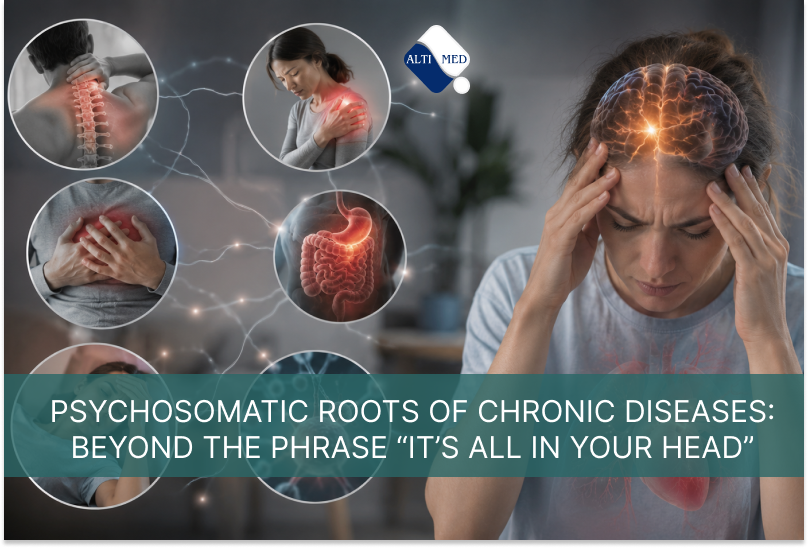
Chronic diseases may have a psychosomatic nature. Yes, illnesses are not always connected only with physiology. But this does not mean that the problem exists only in the mind and that eliminating stress will completely remove disease flare-ups. Behind psychosomatic manifestations hides an entire spectrum of symptoms that are not easy to manage. And classical medications are not always able to help in this matter.
Psychosomatics — A Real Problem or Fiction?
There are many myths surrounding psychosomatics. And not without reason. Many people believe that psychosomatics is nothing more than fiction that cannot influence a person’s condition.
Common Myths:
- All diseases are “from nerves.” Yes, illnesses are connected with psychological factors. But other factors also affect the condition, including genetics, infectious diseases, and injuries.
- Somatic diseases are always mental problems. For example, oncology supposedly develops because of suppressed resentment. And a lump in the throat is believed to be the result of unspoken words or constant silence. This information is not scientific, although there may still be a small element of truth in it.
- A person is personally guilty for being ill. Any disease, even chronic, is supposedly the result of certain actions or inaction. However, heredity, environmental conditions, stress levels, and many other factors should not be ignored.
- Emotions can live only in specific organs. For example, anger supposedly concentrates in the liver, resentment in the kidneys, and fear in the stomach. In reality, psychosomatic manifestations are closely intertwined with physical symptoms.
- Somatic diseases can be treated through awareness alone. It is believed that if a person realizes an emotion, the disease can disappear. In reality, this is possible only when the cause of symptoms truly lies in psychological condition. Simply recognizing emotions or expressing long-suppressed feelings cannot cure somatic manifestations. The approach must be comprehensive.
Psychosomatic diseases may develop in any person. Anyone can experience psychosomatic manifestations — this is a fact. However, no special predisposition is required.
Psychosomatics is a scientific field located at the intersection of psychology and medicine.
Separately, it is important to mention the energetic and physical levels of disease development. Somatic diseases at the energetic level are special conditions associated with disturbances in cellular energy exchange. These pathological states may affect various body systems, including the nervous system, muscles, heart, and other organs. The physical level of disease development involves a combination of genetic, physiological, environmental, and behavioral factors.
“Double” Diseases — Physiological and Psychosomatic
Many diseases have a dual developmental nature. Their manifestations may be both physiological and psychosomatic. Let us consider several common examples.
Autoimmune Diseases
Autoimmune diseases (AID) are a group of pathologies in which the immune system mistakenly attacks the body’s own cells. This is not simply a condition that can be eliminated with pills. It is a complex set of disorders involving loss of tolerance to self-antigens.
Manifestations of autoimmune diseases may be both physiological and psychosomatic.
Physiological Symptoms of Autoimmune Diseases:
- Skin rashes in the form of red plaques.
- Redness around joints and local temperature increase.
- Abdominal pain, stomach discomfort, intestinal disorders.
- Headaches, memory deterioration, anxiety.
Psychosomatic manifestations are different. They appear against the background of internal tension, resentment, and suppressed emotions. A person experiences inflammation, pain, and autoimmune attacks affecting the skin.
Important! It is impossible to completely eliminate the problem, but properly selected therapy may help achieve long-term remission.
Inflammatory Processes in the Body
Inflammatory processes in the body also have physiological and psychosomatic manifestations. Physiological manifestations are associated with changes in tissues, organs, and cells. Psychosomatic manifestations arise from chronic exposure to stress, anxiety, and suppressed emotions.
Physiological Symptoms:
- Local manifestations: skin redness, swelling, local temperature increase, pain.
- Systemic manifestations: weakness, accelerated metabolic processes, intoxication.
Psychosomatic manifestations include pain, gastrointestinal disturbances (nausea, intestinal disorders), shortness of breath, sweating, and breathing difficulties.
The peculiarity of psychosomatic manifestations is that they often do not correspond to medical examination results. According to tests, “everything is normal,” but symptoms and complaints still remain.
Hormonal Imbalance in the Body
Hormonal imbalance also appears in both physiological and psychosomatic aspects. Hormonal disturbances are characterized by fluctuations in estrogen, progesterone, testosterone, and other hormones.
Physiological Manifestations:
- Menstrual cycle disturbances: irregularity and painful periods.
- Skin problems: rashes, dryness, allergic manifestations.
- Hair problems: hair loss, excessive growth on arms, legs, or face.
- Swelling caused by fluid retention.
Reproductive problems and metabolic disturbances may also occur.
Psychosomatic Manifestations:
- Mood swings — from crying episodes to uncontrolled joy.
- Fatigue and lack of energy even after полноценный sleep.
- Problems with concentration.
People with psychosomatic manifestations are more likely to experience anxiety and panic attacks.
Chronic Pain
Chronic pain syndrome may also be physiological or psychosomatic.
Physiological Manifestations:
- Pain of different character and localization.
- Increased pain during movement.
- Local increase in body temperature.
Vegetative disorders are also common, ranging from severe weakness to sleep disturbances and appetite reduction.
Psychosomatic manifestations include irritability, anxiety, loss of interest in life, and depressive symptoms.
It is important to note that chronic pain is not just a symptom. It is an independent disease requiring specialized treatment.
Hardware Diagnostics and Therapy of Psychosomatic Diseases
Psychosomatic diseases can be diagnosed. However, standard laboratory and instrumental examinations are often insufficient. Such tests may show no abnormalities while the problem still remains. According to statistics, more than 40% of people experience symptoms associated with psychosomatic conditions. These symptoms cannot simply be eliminated with medications. A deeper approach is required.
At the medical center Altimed.net modern hardware diagnostic and therapy methods are used:
- Transcranial Magnetic Stimulation (TMS). This method is used to stabilize brain wave activity. The process is performed without medications by normalizing brain waves using specialized equipment.
- Passive Bioresonance Therapy (Passive BRT). This is a proprietary method aimed at normalizing waves within the patient’s body by collecting “damaged” waves and processing them. Stabilized waves are then returned to the body, improving overall well-being.
- Active Bioresonance Therapy (Active BRT). Pathogens may provoke psychosomatic manifestations. Active BRT is used to detect and eliminate such pathogens with their subsequent removal from the body.
We work with the root cause rather than simply suppressing symptoms. And we do this using proprietary methods and equipment developed in-house. Qualified specialists at the medical center are ready to help every patient.
Schedule a consultation. We are waiting for you.


