

What Really Accelerates Biological Aging

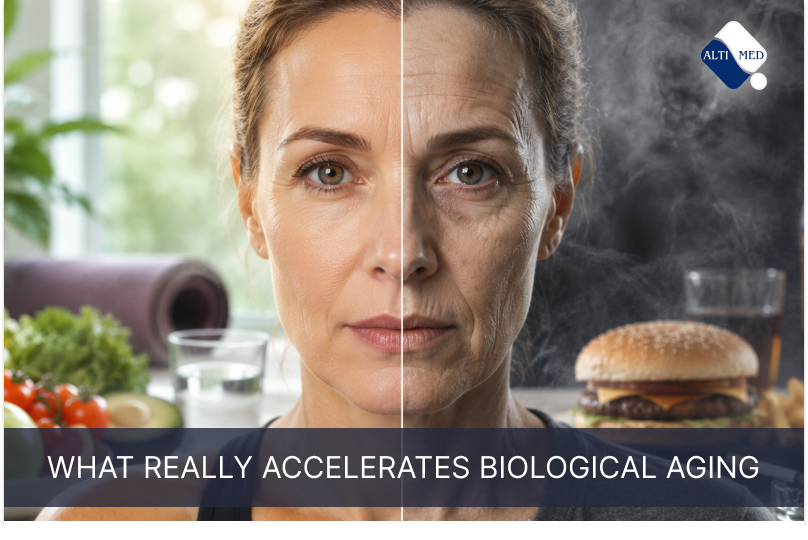
- Why Biological Aging Cannot Be Explained by a Single Cause
- Chronic Stress as a Factor of Physiological Wear and Tear
- Sleep Fragmentation and Impaired Recovery
- Chronic Low-Grade Inflammation
- Metabolic Disorders and Accelerated Aging
- Lack of Physical Activity
- Smoking and Physiological Aging
- Overload Without Recovery
- Why Aging Is Rarely Linked to Just One Factor
- What People Often Misunderstand
- How to Support Healthy Aging
- A Modern Perspective on Biological Age Assessment
- Key Takeaways
- FAQ
- Conclusion
When people hear about aging, many imagine a process that is determined exclusively by the number of years on a birth certificate. However, modern research shows that the rate of aging can vary significantly even among people of the same age. This is why the concept of biological age is being used more frequently – an indicator that reflects the current functional condition of the body.
At the same time, aging is rarely determined by a single factor. In real life, there is no single cause that suddenly makes a person biologically older. Much more often, it is the result of a gradual accumulation of stressors, impaired recovery processes, and physiological changes that simultaneously affect the nervous system, metabolism, immunity, hormonal regulation, and adaptive mechanisms.
Modern science increasingly views accelerated aging as the result of long-term physiological wear and tear on the body caused by multiple interconnected factors. This is why understanding these factors can help people better assess risks and make more informed decisions about their health.
Why Biological Aging Cannot Be Explained by a Single Cause
The human body is a complex system in which all major mechanisms are closely interconnected.
Sleep influences immunity.
Immunity influences inflammation.
Inflammation influences metabolism.
Metabolism influences energy production.
The nervous system participates in regulating all of these mechanisms simultaneously.
As a result, accelerated biological aging more closely resembles the accumulation of many small changes than the impact of a single destructive factor.
This perspective forms the basis of the concept of physiological burden on the body, which many researchers associate with aging processes.
Chronic Stress as a Factor of Physiological Wear and Tear
Stress is a normal part of life.
A short-term stress response helps the body adapt to changes in the environment.
Problems begin to arise when stress becomes chronic.
During prolonged psychological strain, changes may occur in:
- cortisol regulation;
- autonomic nervous system function;
- sleep quality;
- immune activity;
- inflammatory processes;
- energy metabolism.
Research shows that chronic stress exposure can affect multiple body systems simultaneously, creating conditions that may contribute to accelerated functional aging.
For this reason, stress is increasingly viewed not only as a psychological issue but also as a biological health factor.
Sleep Fragmentation and Impaired Recovery
Sleep is one of the most important mechanisms for maintaining health.
During sleep, the following processes occur:
- nervous system recovery;
- regulation of immune activity;
- restoration of energy resources;
- hormonal adjustment;
- cellular repair processes.
However, modern lifestyles often contribute not only to shorter sleep duration but also to poorer sleep quality.
Even if a person spends enough hours in bed, frequent awakenings, shallow sleep, and disrupted circadian rhythms can reduce recovery efficiency.
Over time, a lack of high-quality sleep can influence metabolism, immune regulation, and the body’s adaptive capacity.
Chronic Low-Grade Inflammation
Acute inflammation is necessary for protecting the body.
However, long-term low-grade inflammation is considered one of the factors associated with accelerated aging.
This type of inflammation may be sustained by various causes, including:
- excess body weight;
- chronic stress;
- sleep disturbances;
- a sedentary lifestyle;
- chronic diseases;
- smoking.
Low-grade inflammation does not always produce obvious symptoms, but it can affect multiple organs and body systems over long periods of time.
For this reason, many researchers consider it an important component of age-related changes.
Metabolic Disorders and Accelerated Aging
Metabolic health plays a key role in maintaining the body’s functional condition.
Metabolic disturbances can gradually affect:
- the vascular system;
- hormonal regulation;
- energy metabolism;
- inflammatory processes;
- internal organ function.
Particular attention is currently focused on:
- insulin resistance;
- disorders of glucose metabolism;
- visceral obesity;
- metabolic syndrome.
These conditions often develop gradually and may remain unnoticed for long periods.
Lack of Physical Activity
The human body is naturally adapted to regular physical movement.
When physical activity is insufficient, changes may occur in:
- muscle mass;
- insulin sensitivity;
- cardiovascular function;
- energy metabolism;
- adaptive capacity.
Physical activity affects much more than muscles alone.
It plays a role in supporting nervous system health, metabolism, and recovery mechanisms.
This is why a sedentary lifestyle is considered one of the factors that may accelerate age-related changes.
Smoking and Physiological Aging
Smoking remains one of the most extensively studied factors associated with accelerated aging.
Tobacco smoke affects:
- blood vessels;
- the respiratory system;
- immunity;
- inflammatory processes;
- cellular repair mechanisms.
Numerous studies associate smoking with a higher risk of cardiovascular disease, chronic inflammatory conditions, and premature age-related changes.
Overload Without Recovery
Modern productivity culture often focuses exclusively on workload.
However, adaptation does not occur during stress or effort itself – it occurs during recovery.
If periods of stress, work, exercise, and emotional strain consistently exceed the body’s recovery capacity, a state of chronic resource depletion may gradually develop.
In practice, this may manifest as:
- reduced energy levels;
- poorer sleep quality;
- increased fatigue;
- decreased concentration;
- reduced tolerance to physical and mental demands.
Such a state is increasingly considered a factor that may contribute to accelerated functional aging.
Why Aging Is Rarely Linked to Just One Factor
In real life, these factors rarely exist in isolation.
For example:
- stress worsens sleep;
- poor sleep increases inflammation;
- inflammation affects metabolism;
- metabolic disturbances reduce energy levels;
- low energy decreases physical activity.
As a result, a self-reinforcing cycle develops.
This is why modern healthy aging models increasingly view the body as an integrated system rather than a collection of separate processes.
What People Often Misunderstand
Aging Is Determined Only by Genetics
Genetics plays an important role, but lifestyle and overall health status also have a significant influence on the rate of age-related changes.
One Factor Can Fully Explain Aging
Current evidence suggests that aging is a multifactorial process.
In most cases, it involves several mechanisms acting simultaneously.
Biological Aging Always Produces Symptoms
Some processes may develop gradually and remain unnoticed for long periods.
As a result, deterioration in functional health does not always immediately affect how a person feels.
How to Support Healthy Aging
Although it is impossible to completely stop aging, many risk factors can be modified.
Specialists most commonly recommend:
- maintaining regular physical activity;
- prioritizing sleep quality;
- managing chronic stress;
- supporting metabolic health;
- avoiding smoking;
- ensuring adequate recovery;
- practicing prevention of chronic diseases.
These areas are widely considered the foundation of maintaining functional capacity throughout life.
A Modern Perspective on Biological Age Assessment
Today, aging assessment increasingly extends beyond the simple number shown on a birth certificate.
In addition to standard medical evaluations, various methods of functional screening, comprehensive health assessment, and digital health analysis may be used.
These approaches do not determine the exact rate of aging, but they can help provide a better understanding of the body’s current functional condition and identify factors that may influence long-term health.
Key Takeaways
- Biological aging is a multifactorial process.
- Chronic stress can affect multiple body systems simultaneously.
- Sleep quality plays an important role in recovery processes.
- Metabolic disorders may accelerate functional aging.
- Lack of physical activity reduces the body’s adaptive capacity.
- Smoking remains one of the most extensively studied factors in premature aging.
- Overload without recovery may contribute to chronic physiological wear and tear.
- Aging is more often the result of interactions between multiple factors than a single cause.
FAQ
Conclusion
Biological aging rarely develops because of a single cause. More often, it is the result of the accumulation of multiple factors that gradually increase the body’s physiological burden. Chronic stress, sleep disturbances, inflammation, metabolic changes, physical inactivity, and inadequate recovery do not act independently – they interact with one another and amplify their overall impact.
This is why modern perspectives on healthy aging increasingly focus not on identifying a single “main culprit,” but on understanding the body as an integrated system in which sleep quality, energy levels, immune function, metabolism, and recovery capacity are closely interconnected.


